

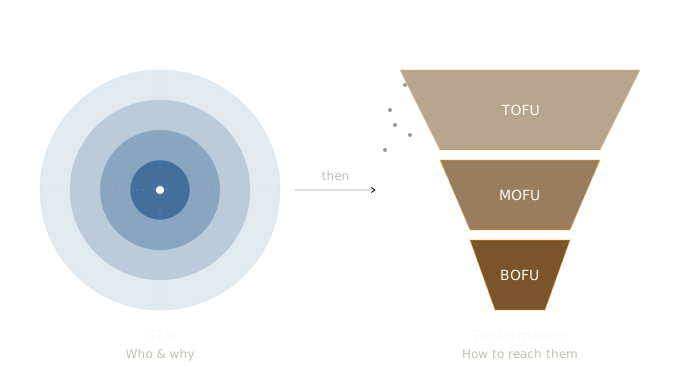
Short answer: GTM strategy is the plan — who you’re selling to, what makes you different, and where they spend time. Performance marketing is how you reach those people at the lowest possible cost. You need both. One without the other either wastes money or wastes the opportunity.
I’ve spent the last several years running go-to-market and performance campaigns for brands across very different industries — healthcare, legal services, Shopify, ed-tech — and the single biggest mistake I see founders make is treating these two things as the same job. They’re not. This post breaks down both, how they connect, and the exact sequence I run when launching anything new in 2026.
What Is a Go-To-Market Strategy?
A GTM strategy is the short-term launch plan that answers three questions before you spend a dollar on ads.
1. Who is this actually for?
You can’t target “everyone.” You need to define:
- Firmographics or demographics — company size, job title, age bracket, geographic market
- Psychographics — what keeps them up at 2 AM, what they’ve already tried that didn’t work, what they’re quietly embarrassed about
- The buying centre — who makes the decision, who signs the cheque, and who actually uses the product day-to-day (often three different people)
For a B2B tool I worked on recently, the decision-maker was a VP of Operations, the cheque-signer was a CFO, and the actual end user was a 24-year-old ops analyst. Same buying centre, three completely different pitches.
2. What makes you different?
This is where most launches stall. You need:
- Product–market fit — does your product actually solve the problem, or are you solving a nice-to-have?
- A competitive matrix — a clear-eyed view of how you compare on the axes that matter to the buyer
- A one-sentence hook — the sharpest possible version of your value prop
A good hook sounds like this: “The only CRM that updates itself so salespeople don’t have to.” A bad hook sounds like: “A next-generation platform for modern sales teams.” One is specific and opinionated. The other could describe any SaaS product built after 2015.
3. Where will you reach them?
You have two broad distribution models:
- Direct — your own website, your own funnel, your own margins
- Indirect — wholesalers, affiliates, marketplaces like Amazon or the Shopify App Store
Most early-stage founders should start direct because you learn faster. Indirect channels work brilliantly once you’ve nailed messaging — but they punish you if your product isn’t tight yet.
What Is Performance Marketing?
Once GTM tells you who and what, performance marketing is how — specifically, how you reach that audience at the lowest possible cost per acquisition.
It’s execution, not strategy. And it lives inside a funnel.
The funnel, simply
Top of Funnel (TOFU — Awareness). Broad targeting on Meta, TikTok, or YouTube to introduce the problem. You’re not selling yet. You’re making people realise they have the problem you solve.
Middle of Funnel (MOFU — Consideration). Google Search ads for people actively hunting solutions — “best CRM for startups,” “Shopify apps for subscriptions,” “MRI near me without insurance.” These are in-market buyers.
Bottom of Funnel (BOFU — Conversion). Retargeting ads to people who visited your pricing page, added to cart, or watched 75% of a demo video. They know who you are. They just need a push.
The math you can’t ignore
Two numbers decide whether your performance marketing is actually working:
- CAC (Customer Acquisition Cost) = total ad spend ÷ new customers
- Payback period = how many months it takes for a customer to pay back their CAC
If your CAC is $200 and the average customer pays you $50 a month, your payback is 4 months. That’s fine for SaaS. For a DTC brand with a $60 AOV and no repeat purchase, it’s catastrophic.
Track both from day one. Every ad dashboard in the world shows you clicks. Very few founders track payback. That’s where the money actually is.
GTM vs Performance Marketing: The Quick Comparison
| Feature | Go-To-Market (GTM) | Performance Marketing |
| Focus | Strategy and product launch | Execution and ROI |
| Duration | Short-term (the launch phase) | Long-term (ongoing growth) |
| Success metric | Market penetration, awareness | CPA, ROAS, conversion rate |
| Key question | “Who is this for, and why?” | “How do I get them to click?” |
| When it matters most | Weeks 0–12 of a launch | Every week after |
| Who owns it | Founder, Head of Product, CMO | Performance lead, media buyer |
The Three-Phase Roadmap I Actually Use
Here’s the exact sequence I run for any new launch. It isn’t complicated, but skipping a phase is expensive.
Phase 1: Pre-Launch (Strategy)
- Market research. 5 to 10 interviews with your ICP. Not a survey — actual conversations where you shut up and listen. You’re hunting for the exact phrasing they use to describe the problem, because that’s the copy you’ll run later.
- Pricing strategy. Freemium, subscription, or one-time. Benchmark against three direct competitors and at least one adjacent category.
- Sales enablement. The pitch deck, the landing page, the email sequence. All of them reflect the same messaging. If your deck says one thing and your landing page says another, your GTM isn’t finished.
Phase 2: Launch (Testing)
- The alpha spend. Small budgets ($20–$100/day) across 3 to 5 variants of your hook. You’re not trying to drive sales yet. You’re trying to find the message that gets a 2%+ CTR.
- Landing page optimization. Hotjar, Microsoft Clarity, or PostHog to watch where people actually drop off. I’ve seen conversions double by moving one button and cutting two paragraphs.
Phase 3: Scale (Optimisation)
- Double down. Move the budget from the failing channels to the winning one. Most founders spread spending evenly because it feels fair. Fair is not a marketing strategy.
- Referral loops. Once you have happy customers, incentivise them to bring more. A $20 referral credit that brings in a customer with a $300 LTV is the cheapest CAC you’ll ever see.
Frequently Asked Questions
Is GTM the same as a marketing plan? No. A marketing plan is annual and covers all activities. A GTM strategy is tactical and tied to a specific launch — a new product, a new market, or a new segment.
Should I hire a performance marketer or an agency first? If your monthly ad spend is under $10K, an experienced freelancer or fractional lead is usually better value than an agency. Agencies make economic sense above roughly $25K/month.
What’s a good CAC for a SaaS product? The healthy benchmark is an LTV:CAC ratio of 3:1 or higher, with payback under 12 months. Below that and you’re building a business that doesn’t scale.
How long should the GTM phase last? For most products, 8 to 12 weeks from strategy to launch. Anything longer and the market moves underneath you. Anything shorter and you’ll miss something important.
What’s the single biggest mistake in product launches? Spending on performance marketing before the GTM message is validated. Running paid ads is the most expensive way to learn you have the wrong positioning. Test with organic posts and real conversations first.
Where to Start This Week
Pick one:
- Launching a new product? Spend this week doing 5 ICP interviews. Don’t write a single ad yet.
- Trying to improve an existing product? Pull your last 90 days of ad data, calculate actual CAC by channel, and kill the bottom 30%.
Both are free. Both will tell you more about your business than any dashboard.
Which one are you in right now — launching something new, or trying to fix performance on something existing? Drop a comment. I read every one, and the patterns across responses usually end up in the next post.