
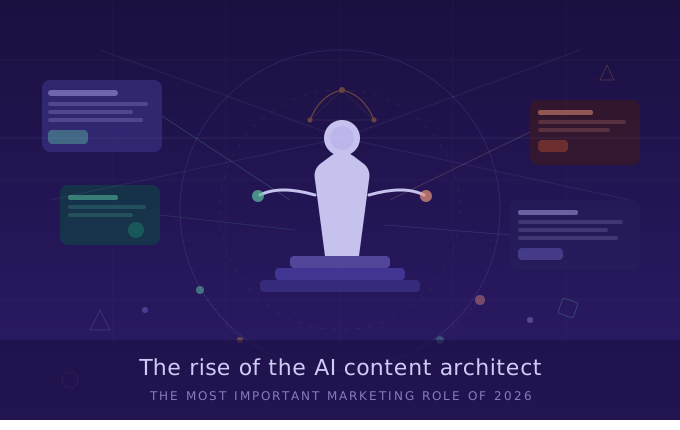
The marketing landscape hasn’t just shifted; it has undergone a complete molecular restructuring. If 2023 was the year of “AI curiosity” and 2024 was the year of “AI implementation,” then 2026 is officially the year of the AI Content Architect.
The traditional Content Strategist—the professional who spent their days managing editorial calendars and brief-to-draft cycles with a stable of freelance writers—is becoming a relic of the past. In their place is a high-level orchestrator who doesn’t just plan content but builds the cognitive infrastructure that generates it.
Here is why the AI Content Architect is the most critical hire for your brand this year, and how the role has evolved from simple strategy to complex system design.
1. Beyond the Chatbox: Prompt Engineering vs. Prompt Architecture
In the early days of Generative AI, we talked about “Prompt Engineering”—the art of coaxing a decent response out of a LLM (Large Language Model) through trial and error. By 2026, Prompt Engineering is a foundational skill, much like typing. The real value has moved to Prompt Architecture.
Why One-Off Chatting is Dead
Standard “chatting” with an AI produces generic, “beige” content. It lacks the idiosyncratic “soul” of a brand. An AI Content Architect understands that a brand’s competitive advantage lies in its Proprietary Prompt Library.
Building Brand-Aware Infrastructure
Prompt Architecture involves building a hierarchical library of prompts that are:
- Context-Injected: Using RAG (Retrieval-Augmented Generation) to ensure the AI accesses the brand’s specific white papers, past successful campaigns, and internal data before writing a single word.
- Persona-Locked: Developing “System Prompts” that define the brand’s voice, ethical boundaries, and “un-copyable” stylistic quirks.
- Modular: Building prompt “chains” where the output of a research prompt feeds into a structural prompt, which then feeds into a creative execution prompt.
The Architect’s Value: They don’t just “ask” the AI to write a blog; they build the machine that ensures every piece of content sounds like it came from the CEO’s brain, not a server farm in Iowa.
2. Orchestrating the “Agentic” Workflow
We have moved past the era of human-led content production. As we discussed in our previous breakdown of how ChatGPT Agents are replacing traditional tools, the modern workflow is now “Agentic.”
An AI Content Architect doesn’t manage a team of human freelancers; they manage a Fleet of AI Agents.
The Virtual Newsroom
In 2026, the Content Architect oversees specialized agents that function autonomously within a defined sandbox:
- The Researcher Agent: Scours real-time web data, academic journals, and social trends to find “content gaps.”
- The SEO Architect Agent: Analyzes Semantic Search patterns and AEO (Answer Engine Optimization) requirements.
- The Multi-Modal Agent: Takes a single long-form pillar post and automatically refines it into a 60-second video script, five LinkedIn posts, and an infographic.
The Architect as “Human-in-the-Loop”
The Architect’s role is no longer to write the first draft, but to provide the Creative Governance. They act as the high-level editor and systems troubleshooter, ensuring the agents don’t drift into “hallucinations” or repetitive patterns. They manage the workflow, not the word count.
3. The New Skillset: Data, Design, and Dialogue
The resume of a 2026 Content Architect looks vastly different from a 2020 Content Marketer. The “soft skills” of storytelling are now augmented by “hard skills” in technical orchestration.
Data Literacy and “Vector” Thinking
Architects must understand how data is structured. They don’t need to be data scientists, but they must understand how Vector Databases help AI remember brand history. They use data to prove ROI not just through clicks, but through “brand sentiment” metrics analyzed by AI sentiment engines.
Generative Engine Optimization (GEO)
SEO is no longer just about Google’s 10 blue links. The Architect focuses on GEO (Generative Engine Optimization). This means optimizing content so that it is cited by Perplexity, Gemini, and ChatGPT’s search features.
- Citation Management: Ensuring your brand’s original research is structured in a way that AI models can easily “crawl and credit.”
- Direct Answer Strategy: Crafting content that answers complex, conversational queries better than a Wikipedia entry.
Community Management and “Human-Centric” Loops
As AI content floods the internet, the value of Human Community skyrockets. The AI Content Architect spends significant time managing the “feedback loop” from real humans. They take community insights from Discord or Reddit and feed those “human truths” back into the AI’s architecture to ensure the content remains grounded in reality.
4. Why 2026 is the “Tipping Point”
According to research from Gartner, by 2026, 80% of advanced creative roles will require proficiency in AI orchestration. We are seeing a “Barbell Effect” in the job market:
- The Bottom: Entry-level writing jobs are being fully automated.
- The Top: The role of the “Architect” is seeing a massive increase in compensation and strategic importance.
The Architect is the bridge between the CMO’s vision and the AI’s execution. Without the Architect, a company’s AI output is just noise. With them, it is a precision-guided weapon.
5. Transitioning from Strategist to Architect: A Roadmap
If you are currently a content strategist, here is how you evolve before the market leaves you behind:
- Master the API, not just the UI: Stop using the web interface of ChatGPT. Start experimenting with Playgrounds and APIs to understand how parameters like “Temperature” and “Top-P” affect output.
- Learn Logic Mapping: Content is now a series of “If/Then” statements. Practice mapping out your content workflows using tools like Zapier or Make.com.
- Build a “Second Brain”: Start organizing your brand’s knowledge into a structured format (like Notion or Obsidian) that can be used as a “Knowledge Base” for future AI agents.
Final Thoughts: The Human Advantage
Does the rise of the AI Content Architect mean the “death” of the writer? No. It means the ascension of the thinker.
The Future belongs to those who can speak the language of machines while maintaining the heart of a storyteller. In 2026, we aren’t just writing articles; we are building worlds.
Are you ready to stop writing and start architecting?
Interested in more insights on the intersection of tech and lifestyle? Check out our latest guides on GeeklyMarried.com.